Posts

Showing posts with the label Thematic Topics

IB Course Concluding Portfolio

Image
Daniel Arcega Mrs. Emerick IB English HL II IB Course Concluding Portfolio Over the two years of IB English, I’ve read a total of 14 works. When reviewing those works, I realized that The Things They Carried from year one and The Dew Breaker had similar themes and structures. When I investigated further, I realized the other books had similar connections. For each book in year one, there was often a similar book in year two. This portfolio will go over the connections I found between these stories and my thoughts on them. How to Read Literature Like a Professor and Hamlet           I’m going to start with the first book I ever read for IB, How to Read Literature Like a Professor by Thomas Foster. I have decided to connect this book with Hamlet by William Shakespeare because of both novels’ relation to the art of literature. Unlike the rest of the novels on this list, these two do not have any overlapping themes and are not even the same type of work....

The Scarlet Letter Creative Portfolio

Image
Daniel Arcega Mrs. Emerick IB English HL II Scarlet Letter Creative Portfolio     Seen above is a physical recreation of the titular scarlet letter worn by Hester Prynne in The Scarlet Letter by Nathanial Hawthorne. The letter is made distinct by the gold threading which Hester herself sewed into it. However, Hester isn't the only character who bears a mark of shame. I decided to recreate what I believe these symbols would be, if they manifested physically, for the other important characters in the novel.      The letter above represents the brand upon Minister Dimmesdale's chest. As implied in the story, he wears the same symbol as Hester since they share the same crime. However, the detailing of the two letters is what differentiates them. Hester's letter is adorned in golden thread by her own hand, representing how she willing shows it off to the world. In comparison, Dimmesdale's letter is marred by splotches which symbolize the corruption of his s...

The Handmaid's Tale Context Portfolio

Image
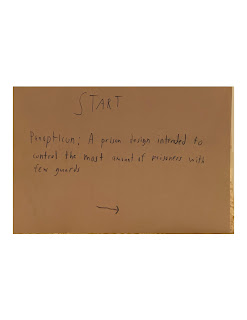
Daniel Arcega Mrs. Emerick IB English HL II Socio-Historical Context           For my historical context portfolio, I created a model of a panopticon. A panopticon relates to The Handmaid's Tale because the society depicted in the novel is similar to that of a panopticon. On the outside is the description of a panopticon along with real-life examples as well as its connection in The Handmaid's Tale. On the inside is a ring of prison cells, creating a model panopticon. Works Cited “Internalized Authority and the Prison of the Mind: Bentham and Foucault's Panopticon.” HAAW Workplace , Brown University, 2009, https://www.brown.edu/Departments/Joukowsky_Institute/courses/13things/7121.html.    Foucault, Michel. Discipline and Punish: The Birth of the Prison. Trans. Alan Sheridan. New York: Pantheon, 1977.

Doubt Final Topics

Daniel Arcega Mrs. Emerick IB English HL II Doubt Final Topics #1: Film Critique     The film technique used in the theatrical version of doubt that I will overview is the way in which the film characterizes Sister Aloysius through her actions and the actions of others. In the novel, there is only basic scene descriptions to give the reader a general perspective of the scene and its characters. The characters are rarely described doing actions. The reader must make assumptions about the characters based on these initial descriptions and dialogue. Based on Sister Aloysius's dialogue, the reader can gleam that she is a traditional and strict principal, attempting to keep an eye on her entire school. However, a clearer picture of Sister Aloysius's character is presented in the film version due to the actions she takes.       The film version of the story not only has more scenes overall, but the ability to convey information through actions. The...

Year Two 2nd MP Index

Hamlet and The Stranger Dialectical Portfolio Hamlet,Relationships,The Stranger,Character,In,Comparison,Thematic Topics,Identity, Hamlet and The Stranger Final Topic Hamlet,Character,The Stranger,Comparison,In,Thematic Topics, Hamlet and Stranger Creative Portfolio Hamlet,Character,The Stranger,Comparison,Violence,In, Doubt Character Portfolio Character,Symbolism,In,Identity,Doubt,

Hamlet and The Stranger Final Topic

Daniel Arcega Mrs. Emerick IB English HL II November 30 2021 Hamlet and The Stranger Final Topics D.3 Hamlet and The Stranger use the main protagonists’ internal dialogue to give the reader insight into their character. Hamlet’s soliloquies are used to show the audience his internal conflict.  Hamlet’s internal conflict originates from a sense of uselessness. His soliloquy in act one scene two describes to the audience how powerless he feels. “But break, my heart, for I must hold my tongue”(Shakespeare 1.2.159). The entire soliloquy is about how Hamlet despises the marriage between Claudius and Gertrude, yet at the end of it he relents that he is unable to speak his true feelings. Further on in the story, twice is Hamlet shown his inability to carry out his revenge. After watching the player act: “Yet I, A dull and muddy-mettled rascal, peak Like John-a-dreams, unpregnant of my cause”(Shakespeare 2.2.561-563). Hamlet is angered that he is not enraged at his father’s murder but he ...

Hamlet and The Stranger Dialectical Portfolio

Daniel Arcega Mrs. Emerick IB English HL II Hamlet and The Stranger Dialectical Portfolio Part 1: Use of the death of a parent Hamlet : Father is dead Learn much about the character because of it Spurs him into action The Stranger : Mother is dead Learn much about the character because of it Forces him into action     In both Hamlet  and The Stranger , the main characters experience the death of a parent early in the novel to introduce the readers to their characters and spur them into action.     Hamlet opens around two months after the titular character's father has died. Hamlet's first introduction illustrates that the event still heavily plagues Hamlet. Reflecting on what has happened, he laments " Oh, that this too, too sullied flesh would melt, t haw, and resolve itself into a dew,  or that the Everlasting had not fixed h is canon 'gainst self-slaughter!"(Shakespeare 129-132). Hamlet feels useless due to his inability to fix his sadness or s...