Posts

Showing posts with the label Comparison

IB Course Concluding Portfolio

Image
Daniel Arcega Mrs. Emerick IB English HL II IB Course Concluding Portfolio Over the two years of IB English, I’ve read a total of 14 works. When reviewing those works, I realized that The Things They Carried from year one and The Dew Breaker had similar themes and structures. When I investigated further, I realized the other books had similar connections. For each book in year one, there was often a similar book in year two. This portfolio will go over the connections I found between these stories and my thoughts on them. How to Read Literature Like a Professor and Hamlet           I’m going to start with the first book I ever read for IB, How to Read Literature Like a Professor by Thomas Foster. I have decided to connect this book with Hamlet by William Shakespeare because of both novels’ relation to the art of literature. Unlike the rest of the novels on this list, these two do not have any overlapping themes and are not even the same type of work....

THT and TSL Paper 2 Final Topics

  Daniel Arcega Mrs. Emerick IB English HL II Compare the presentation and function of villains or anti-heroes in at least two works of prose fiction that you have studied. Both The Handmaid’s Tale and The Scarlet Letter have two antagonists: society and a person, which both serve to affect the protagonists’ freedom. The societies within the two novels oppress their protagonists’ freedom, yet contrarily also elevate them in some ways. In The Scarlet Letter , Hester’s life throughout the novel is under the strict watch of society. However, its influence transforms as time goes on. Society initially rejects Hester due to her sin. She is unable to make any lasting connections with others. (quote here) Society’s judgment eventually shifts to see Hester in a more positive light. She eventually becomes known as a treasure of the town. She feels more free to walk around the town. (quote here) Her society both oppressed her and raised her up. On the other hand, Gilead in The Handmaid’s T...

The Scarlet Letter Creative Portfolio

Image
Daniel Arcega Mrs. Emerick IB English HL II Scarlet Letter Creative Portfolio     Seen above is a physical recreation of the titular scarlet letter worn by Hester Prynne in The Scarlet Letter by Nathanial Hawthorne. The letter is made distinct by the gold threading which Hester herself sewed into it. However, Hester isn't the only character who bears a mark of shame. I decided to recreate what I believe these symbols would be, if they manifested physically, for the other important characters in the novel.      The letter above represents the brand upon Minister Dimmesdale's chest. As implied in the story, he wears the same symbol as Hester since they share the same crime. However, the detailing of the two letters is what differentiates them. Hester's letter is adorned in golden thread by her own hand, representing how she willing shows it off to the world. In comparison, Dimmesdale's letter is marred by splotches which symbolize the corruption of his s...

MP3 Choice Portfolio

Daniel Arcega Mrs. Emerick IB English HL II Reconstruction in The Scarlet Letter           Within The Handmaid’s Tale, reconstruction is a device Offred uses in order to maintain a sense of power in her uncontrollable life. She takes events she has experienced and envisions different versions of them and imagines different outcomes. This results in many versions of the same story of which neither Offred nor the reader know the truth of reality. Similarly, the tale of The Scarlet Letter is painted as a reconstruction. Its narrator takes the stories of Hester he finds in papers and produces a streamlined narrative. As such, parts of the story can be scrutinized as to whether or not they actually occurred as the narrator claims. The potential differences in the events of the novel can lead to them having different significance. One scene that can be interpreted in a couple ways is the scaffold scene in chapter twelve. Specifically the moment where Dimmesdale...

Hamlet and Stranger Creative Portfolio

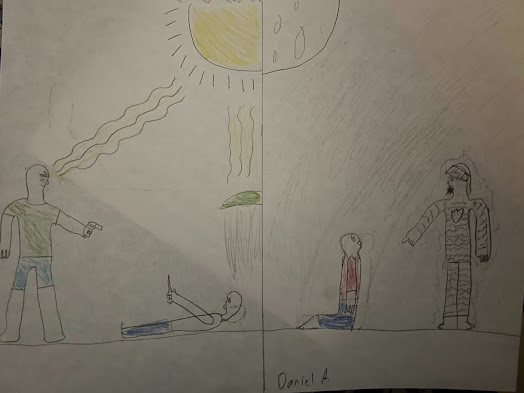
Image
Daniel Arcega Mrs. Emerick IB English HL II Turning Point Art     Above is a picture that I drew of what I believe are two important moments in Hamlet and The Stranger . I chose these two events to draw not only because they are turning points for the main character, but also because how they compare and contrast. Both scenes set in motion the circumstances that lead to the main characters' deaths. The scene on the left is Meursault shooting the man on the ground. The scene on the right is Hamlet's conversation with the ghost in act 1 scene 5. As soon as Meursault pulls the trigger, he seals his fate to ridiculed for his character and die. Similarly, when Hamlet agrees to avenge his father, he is set on a path in which his personal failures bring ruin to himself and those around him. The setting on the left is overwhelmingly bright due to the sun, and Meursault is the one in the dominant position. Contrarily, the Hamlet scene takes place at night with Hamlet in awe/fear of the...

Hamlet and The Stranger Final Topic

Daniel Arcega Mrs. Emerick IB English HL II November 30 2021 Hamlet and The Stranger Final Topics D.3 Hamlet and The Stranger use the main protagonists’ internal dialogue to give the reader insight into their character. Hamlet’s soliloquies are used to show the audience his internal conflict.  Hamlet’s internal conflict originates from a sense of uselessness. His soliloquy in act one scene two describes to the audience how powerless he feels. “But break, my heart, for I must hold my tongue”(Shakespeare 1.2.159). The entire soliloquy is about how Hamlet despises the marriage between Claudius and Gertrude, yet at the end of it he relents that he is unable to speak his true feelings. Further on in the story, twice is Hamlet shown his inability to carry out his revenge. After watching the player act: “Yet I, A dull and muddy-mettled rascal, peak Like John-a-dreams, unpregnant of my cause”(Shakespeare 2.2.561-563). Hamlet is angered that he is not enraged at his father’s murder but he ...