Posts

Showing posts with the label Character

THT and TSL Paper 2 Final Topics

  Daniel Arcega Mrs. Emerick IB English HL II Compare the presentation and function of villains or anti-heroes in at least two works of prose fiction that you have studied. Both The Handmaid’s Tale and The Scarlet Letter have two antagonists: society and a person, which both serve to affect the protagonists’ freedom. The societies within the two novels oppress their protagonists’ freedom, yet contrarily also elevate them in some ways. In The Scarlet Letter , Hester’s life throughout the novel is under the strict watch of society. However, its influence transforms as time goes on. Society initially rejects Hester due to her sin. She is unable to make any lasting connections with others. (quote here) Society’s judgment eventually shifts to see Hester in a more positive light. She eventually becomes known as a treasure of the town. She feels more free to walk around the town. (quote here) Her society both oppressed her and raised her up. On the other hand, Gilead in The Handmaid’s T...

The Handmaid's Tale Loaded Lines

Daniel Arcega Mrs. Emerick IB English HL II The Handmaid's Tale Loaded Lines "To put her out of her misery, and myself as well. To put her out of our misery"(292).     The wording that I think is important here is "our misery". This wording suggests that despite Offred's and Serena's different roles in society, they both share the same misery. I believe this connects to the theme of gender explored by Gilead's society. Even though Serena has much more privileges than Offred, she is still a woman. Their gender leads them both to be oppressed, in different ways, under the patriarcal society of Gilead. " I'll sacrifice. I'll repent. I'll abdicate. I'll renounce"(286).      The use of asyndeton makes this line sound like a pledge, like how Offred is promising all these things to God. Additionally, the specific word choices all have subtly different meanings which affect the overall message of the line. "Sacrifice", and...

The Scarlet Letter Creative Portfolio

Image
Daniel Arcega Mrs. Emerick IB English HL II Scarlet Letter Creative Portfolio     Seen above is a physical recreation of the titular scarlet letter worn by Hester Prynne in The Scarlet Letter by Nathanial Hawthorne. The letter is made distinct by the gold threading which Hester herself sewed into it. However, Hester isn't the only character who bears a mark of shame. I decided to recreate what I believe these symbols would be, if they manifested physically, for the other important characters in the novel.      The letter above represents the brand upon Minister Dimmesdale's chest. As implied in the story, he wears the same symbol as Hester since they share the same crime. However, the detailing of the two letters is what differentiates them. Hester's letter is adorned in golden thread by her own hand, representing how she willing shows it off to the world. In comparison, Dimmesdale's letter is marred by splotches which symbolize the corruption of his s...

MP3 Choice Portfolio

Daniel Arcega Mrs. Emerick IB English HL II Reconstruction in The Scarlet Letter           Within The Handmaid’s Tale, reconstruction is a device Offred uses in order to maintain a sense of power in her uncontrollable life. She takes events she has experienced and envisions different versions of them and imagines different outcomes. This results in many versions of the same story of which neither Offred nor the reader know the truth of reality. Similarly, the tale of The Scarlet Letter is painted as a reconstruction. Its narrator takes the stories of Hester he finds in papers and produces a streamlined narrative. As such, parts of the story can be scrutinized as to whether or not they actually occurred as the narrator claims. The potential differences in the events of the novel can lead to them having different significance. One scene that can be interpreted in a couple ways is the scaffold scene in chapter twelve. Specifically the moment where Dimmesdale...

Doubt Final Topics

Daniel Arcega Mrs. Emerick IB English HL II Doubt Final Topics #1: Film Critique     The film technique used in the theatrical version of doubt that I will overview is the way in which the film characterizes Sister Aloysius through her actions and the actions of others. In the novel, there is only basic scene descriptions to give the reader a general perspective of the scene and its characters. The characters are rarely described doing actions. The reader must make assumptions about the characters based on these initial descriptions and dialogue. Based on Sister Aloysius's dialogue, the reader can gleam that she is a traditional and strict principal, attempting to keep an eye on her entire school. However, a clearer picture of Sister Aloysius's character is presented in the film version due to the actions she takes.       The film version of the story not only has more scenes overall, but the ability to convey information through actions. The...

Year Two 2nd MP Index

Hamlet and The Stranger Dialectical Portfolio Hamlet,Relationships,The Stranger,Character,In,Comparison,Thematic Topics,Identity, Hamlet and The Stranger Final Topic Hamlet,Character,The Stranger,Comparison,In,Thematic Topics, Hamlet and Stranger Creative Portfolio Hamlet,Character,The Stranger,Comparison,Violence,In, Doubt Character Portfolio Character,Symbolism,In,Identity,Doubt,

Doubt Character Portfolio

Daniel Arcega Mrs. Emerick IB English HL II Doubt Character Exploration          For my character portfolio, I created a presentation that investigates the perspective of Sister Aloysius. In other words, it explores how she views the things around her. The slides contain an image of something. Next to that image is an explanation on how Sister Aloysius sees it. The explanation is placed in two circles to represent the glasses that Sister Aloysius sees through. Each explanation also comes with supporting evidence in the form of quotes. Presentation Here

Hamlet and Stranger Creative Portfolio

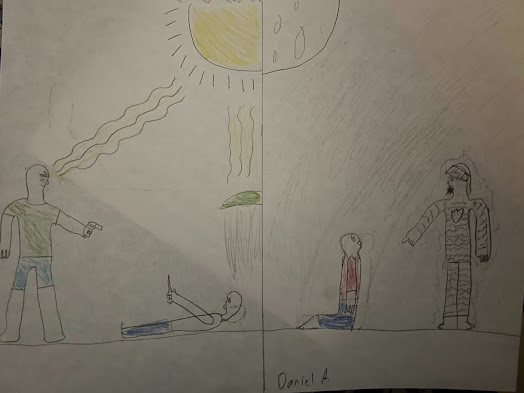
Image
Daniel Arcega Mrs. Emerick IB English HL II Turning Point Art     Above is a picture that I drew of what I believe are two important moments in Hamlet and The Stranger . I chose these two events to draw not only because they are turning points for the main character, but also because how they compare and contrast. Both scenes set in motion the circumstances that lead to the main characters' deaths. The scene on the left is Meursault shooting the man on the ground. The scene on the right is Hamlet's conversation with the ghost in act 1 scene 5. As soon as Meursault pulls the trigger, he seals his fate to ridiculed for his character and die. Similarly, when Hamlet agrees to avenge his father, he is set on a path in which his personal failures bring ruin to himself and those around him. The setting on the left is overwhelmingly bright due to the sun, and Meursault is the one in the dominant position. Contrarily, the Hamlet scene takes place at night with Hamlet in awe/fear of the...

Hamlet and The Stranger Final Topic

Daniel Arcega Mrs. Emerick IB English HL II November 30 2021 Hamlet and The Stranger Final Topics D.3 Hamlet and The Stranger use the main protagonists’ internal dialogue to give the reader insight into their character. Hamlet’s soliloquies are used to show the audience his internal conflict.  Hamlet’s internal conflict originates from a sense of uselessness. His soliloquy in act one scene two describes to the audience how powerless he feels. “But break, my heart, for I must hold my tongue”(Shakespeare 1.2.159). The entire soliloquy is about how Hamlet despises the marriage between Claudius and Gertrude, yet at the end of it he relents that he is unable to speak his true feelings. Further on in the story, twice is Hamlet shown his inability to carry out his revenge. After watching the player act: “Yet I, A dull and muddy-mettled rascal, peak Like John-a-dreams, unpregnant of my cause”(Shakespeare 2.2.561-563). Hamlet is angered that he is not enraged at his father’s murder but he ...

Hamlet and The Stranger Dialectical Portfolio

Daniel Arcega Mrs. Emerick IB English HL II Hamlet and The Stranger Dialectical Portfolio Part 1: Use of the death of a parent Hamlet : Father is dead Learn much about the character because of it Spurs him into action The Stranger : Mother is dead Learn much about the character because of it Forces him into action     In both Hamlet  and The Stranger , the main characters experience the death of a parent early in the novel to introduce the readers to their characters and spur them into action.     Hamlet opens around two months after the titular character's father has died. Hamlet's first introduction illustrates that the event still heavily plagues Hamlet. Reflecting on what has happened, he laments " Oh, that this too, too sullied flesh would melt, t haw, and resolve itself into a dew,  or that the Everlasting had not fixed h is canon 'gainst self-slaughter!"(Shakespeare 129-132). Hamlet feels useless due to his inability to fix his sadness or s...